Why is exporting so difficult for French companies?
You laugh when you say it – and it's kind of funny – but it's true, isn't it? Even if exporting seems sexy and attractive, its success requires skills, patience and perseverance.
Here are five reasons why EXPORTING can be difficult:
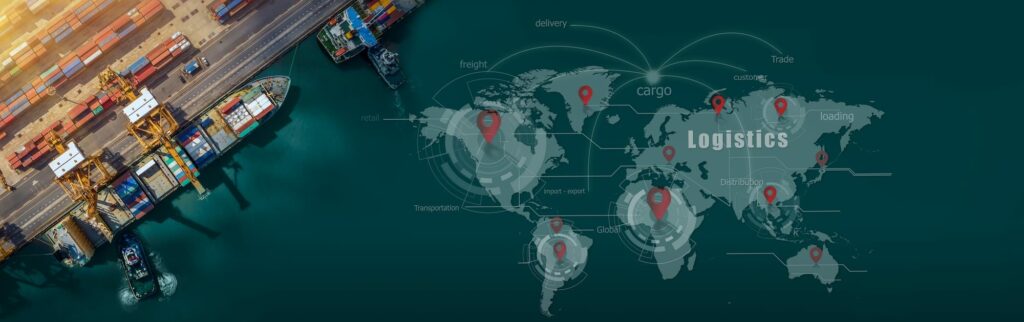
The transport of goods is often described as transport from point A to point B, but the complexity of the transport of goods lies in the multiplicity of the elements that make it up, and in reality it is more like a point A to a point Z, because it includes a large number of stages that are difficult for many companies to manage, especially VSEs & SMEs, which have limited financial, material and human resources.
1. The distance between the seller and the buyer
Exporting requires a certain physical distance between the seller and the buyer, which you don't have to worry about if you sell to your neighbors or even in other cities in France. Exporting is difficult because you have to find the right people to market your products, convince them and deliver to them. When you are used to shipping your goods by truck and you decide to become an exporter, you have to find other means of transport by setting up a suitable logistics chain and make sure you fill in the correct transport documents for each shipment.
2. Linguistic and cultural differences
You'll face a language barrier unless you only export to French-speaking countries. You may also encounter cultural issues, with unfamiliar customs and business standards. Not being aware of these elements when you export can waste your time, and if your shipment is delayed, it can cost you money.
3. Trade terms
The key to international trade relations is the term « Incoterms ». If you're a new exporter, these export trade terms may make you want to rethink your business completely. Incoterms can be complicated and require a good understanding. There are 11 Incoterms that can be grouped into 4 categories:
- Group E Incoterms: The seller has a minimal obligation, with no risk-taking. They only need to make the packaged goods available to the buyer.
- Group F Incoterms: The buyer is responsible for the risks and costs as soon as the goods are handed over to the carrier. The seller does not organize the main transport.
- Group C Incoterms: The seller bears the cost of main carriage and assumes the costs (transport and insurance), but not the risks in the event of damage.
- Group D Incoterms: The seller has maximum responsibility. It assumes the risks and transport costs until delivery to the buyer at the designated location.
The International Chamber of Commerce generally updates the Incoterms every 10 years. The Incoterms 2020 rules came into force on January 1, 2020. If you don't have much experience with Incoterms, 5AM LOGISTICS will help you select the appropriate Incoterm for your international shipments.
4. Crossing borders: Customs regulations
The very nature of exporting means you have to work with different customs authorities, different regulations and a myriad of legal requirements. In addition to these national regulations, you also face the requirements of non-European Union (EU) countries. This doubles your workload and the risk of delays or penalties.
In France, it is almost compulsory for any exporter (or importer) to use a registered Customs Representative.
Thanks to its proven experience in the field, 5AM LOGISTICS can meet all your requests and handle your customs operations in France and worldwide.
5. Exporting is good, getting paid is better!
In addition to the regulatory, certification, customs and other administrative complexities associated with exporting, the risk of non-payment remains the main obstacle to exporting.
When you export to a third country, how do you ensure payment for your shipment? You have to manage different currencies, different banks, different documentation and different financing structures, and all these elements make payment more difficult to set up. You also need to consider customer risk and solvency. It's difficult for exporters to know whether the person is solvent or whether they should be paid in advance. In addition to customer risk, you also run the risk associated with country risk: some countries are simply more difficult to deal with than others.
Several payment systems are possible, with increasing security:
- checks: to be avoided (risk of forgery, loss, objection, etc.), including bank checks, whose regulations are not the same in all countries (in some, it is only guaranteed for 8 days, etc.)
- SEPA or SWIFT transfer: this is the simplest, fastest, cheapest and most commonly used method internationally, but it does not guarantee payment.
- endorsed draft (or stand-by letter of credit): simple and effective, the draft is a bill of exchange that includes a bank guarantee granted by the buyer's bank in favor of the seller.
- documentary collection: the French bank sends the documents to the foreign bank, which is responsible for handing them over to the buyer against payment. As this is a bank-to-bank dialogue, payment is a little more secure, but this method should be used with caution in certain countries or with certain at-risk customers, as the foreign bank's commitment remains limited.
- documentary credit (CREDOC): this is the bank of international payment, with a 100% and irrevocable commitment from the issuing bank to pay on sight or at maturity against submission of documents, and you can even request a confirmed CREDOC which commits the French bank to pay us no matter what. That said, French banks will not confirm all banks in all countries... Pricing depends on the amount and risk, but you should allow €500 for an invoice of €50,000. In all cases, it is preferable not to ship anything (or even start production) until the CREDOC has arrived, and for large projects lasting several months, it is possible to proceed in several tranches. It's a bit cumbersome to set up the first time, but easily reproducible.
Is exporting worth it?
« If it were easy, anyone could do it. »
It's a cliché, but it's true, especially in the field of exporting. There are strategies and tools that can make things easier:
Selecting trusted partners is an essential element in the success of an export project. But it's not always easy to find the right contacts. Advice.
Team Export, International Chamber of Commerce, French Chambers of Commerce International are historical and natural partners of the French CCI. The two networks collaborate in many areas, including the Team France Export program.
Get help from a reliable freight forwarder with extensive expertise in international transport.
5AM LOGISTICS is an expert in freight forwarding and overseas logistics. We implement TRANSPORT and LOGISTICS solutions worldwide.
We work alongside our clients on the overall management of their supply chain, from sourcing to delivery to end customers.
WHY CHOOSE 5AM LOGISTICS FOR YOUR EXPORTS?
You choose your impact on the planet!

For your WORLD export needs, we coordinate directly with your suppliers and ensure that your goods arrive at the right time and at the right price.
Our teams based in France take care of your export operations from the point of production of your goods to the final point of delivery.