Foreign operators wishing to clear their goods reliably and quickly with French Customs must follow a few simple principles and choose their partners.
When importing into France from a third country or exporting from the European Union, the EORI number is mandatory.
- An EORI number is mandatory for any economic operator carrying out imports and/or exports to/from the European Union.
- Each EORI number is unique and valid in all member states of the European Union.
How can you obtain an EORI number?
- To prevent your goods from being blocked at the border and incurring additional logistics costs, we recommend that you obtain your EORI number in advance.
What is an EORI number?
EORI stands for Economic Operator Registration and Identification. It is a unique community identification number, assigned to economic operators and necessary to carry out all their customs formalities within the European Union. An EORI number is required to carry out imports and exports within the European Union and is valid in all EU member states.
The EORI number is used by customs authorities for many purposes: data, statistics, security, etc.
Do you need an EORI number for your imports and/or exports within the EU?
An EORI number is mandatory for all companies, regardless of where they are established. This means that European and non-European companies need an EORI number to trade and carry out customs formalities in Europe.
Private individuals may be granted an exception if their operations are deemed "occasional", in which case they may be exempt from obtaining an EORI number. We are available to analyze your situation.
Customs duties and taxes?
The product you wish to import may be shipped from a country outside the European Union (EU). In the latter case, customs rules will apply when the product enters France, including restrictions and, beyond the allowances, taxation (VAT and customs duties).
As a private individual, you can benefit from allowances in value and quantity when you make non-commercial shipments from private individual to private individual.
These shipments must meet certain conditions.
- they are of an occasional nature;
- they relate exclusively to goods intended for the personal or family use of the recipients;
- they are sent without payment of any kind.
To qualify for the allowance, the intrinsic value (excluding transport and insurance costs) of the goods must not exceed a certain threshold.
These value conditions also apply to gifts.
Depending on the type of exchange and the value of your shipment, the package may be subject to VAT and/or customs duties. The allowance only applies when the value of the goods is less than or equal to €45 for VAT and €150 for customs duties.
Customs duties are generally 12% (the highest rate), but vary between 6.3% and 12%. Please do not hesitate to contact Infos Douane Service in advance or online with the RITA encyclopedia or with 5AM LOGISTICS .
What are the customs formalities in France?
This step is not only important, but also required for import and export procedures. You must produce various documents providing information on the nature of the items, their origin, their size and their value, among other things, in order to obtain authorization from the competent authorities to enter the country. If the documents are not in order, your products will be held and the costs will be at your expense.
What is a document package?
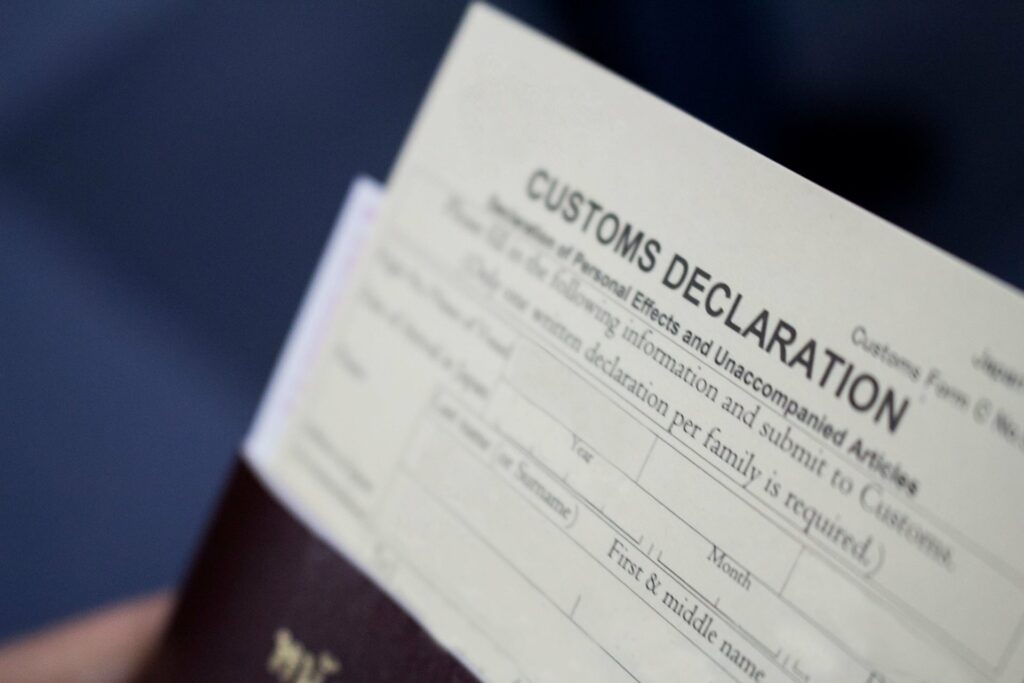
The document package refers to all the documents needed to carry out an international logistics operation.
The list of documents is specific to each situation. You must list all the documents (commercial, logistical, customs, etc.) that you need to collect in order to carry out the customs formalities. Some documents will have to be produced by your company and others by third parties. 5AM LOGISTICS can assist you in preparing the document package for import or export. There are many documents, below is a non-exhaustive list:
- Commercial, consular, customs invoice.
- Packing list
- Inspection certificate
- Insurance certificate
- Declaration of dangerous goods
- EC declaration of conformity
- Certificates of origin and movement
- Export declaration
- CE marking
- Transport document, bill of lading, AWB, CMR, waybill, etc.
- Customs representation mandate
- Import or export license
- Nomenclature of goods to be imported or exported
- EORI number
- Intra-community VAT number
The commercial invoice
The commercial invoice is an accounting document that confirms the terms of sale for goods or services. It is mandatory for all sales between professionals (goods or services). It is used to establish export and import declarations, transport documents, customs value, certificates, licenses, etc.
In the absence of a sale, and therefore payment, between the exporter and the importer, a pro-forma invoice or a recorded invoice on which the supplier indicates 'no charge for consignee', 'value for customs purposes only' or equivalent wording in French must be issued.
Packing list
This is the packing list, which is always included in the set of documents and lists all the packages making up a shipment. This list makes it possible to check that the shipment conforms to the order, i.e. to the invoice drawn up by the seller.
It indicates the identification of each package (marks, numbers, weight, etc.) and also gives the totals for the shipment (number of packages, volume, gross weight, etc.) and the packaging.
Customs representation mandate
In accordance with Article 18 of the Union Customs Code, 'any person may appoint a customs representative to carry out customs acts or formalities with the customs authorities'. This representative must be able to provide proof of their authorization to the customs authorities, via a power of representation.
Export and import licenses
The movement of certain types of goods is subject to restrictions. In this case, an export or import license will be required for any cross-border movement. It must be obtained prior to export or import.
Article 38 of the CDN lists the goods for which export or import is subject to license: www.legifrance.gouv.fr
Certificates of conformity
The import from a third country of toys, childcare accessories, electrical equipment or personal protective equipment requires the presentation of a certificate of conformity during customs clearance to prove that the goods meet European product conformity requirements. Its absence can lead to my goods being blocked in customs.
Thus, any import of industrial products from the United Kingdom to the European Union must meet the conformity requirements set by the European Union, and the production of a certificate of conformity will become necessary.
Sanitary and phytosanitary controls
Border controls are carried out when importing live animals, plants and animal products from third countries.
With Brexit, SPS (Sanitary and Phytosanitary) import controls on consignments from the United Kingdom will be carried out at the border. These checks will be carried out before customs clearance. They consist of a documentary check of the (phyto)sanitary certificate, which may be supplemented by identity and physical checks requiring actual presentation of the consignment at the border post (randomly, or systematically for certain flows such as live animals).
5AM LOGISTICS' CUSTOMS SERVICE: EXPERTISE GUARANTEED PEACE OF MIND!
Our objective?
To offer you peace of mind and save you time by taking care of all customs formalities in all French ports and airports, both for import and export, whatever your types of goods.
Within 5AM LOGISTICS France, specialist customs teams are at your disposal to answer all your requests.
YOU AREN’T CHOOSING LOGISTICS; YOU ARE CHOOSING YOUR IMPACT ON THE PLANET!
L.Robineau – CEO 5AM LOGISTICS